
#7 - Dunning-Kruger effect
You don't know what you know - or don't know
What is leadership, at its core, if not making decisions?
Whether you run a team of three or a company of a thousand, whether you’re a founder negotiating with your co-founder or a manager navigating competing priorities - your job is to cut through the noise and move things forward.
The more responsibility you take on, the more decisions land on your desk - and the higher the stakes of each one. Your brain becomes your most critical business asset. It’s your sharpest tool in every strategy session, every crisis, every moment when people are waiting for you to decide.
The problem is, your brain wasn’t built for this.
This week, we’re diving into the bias that makes you think you’ve mastered a subject - when you’ve barely scratched the surface. Or worse: the one that stops you from seeing that you actually ARE the expert.

You think you’ve “got this”? That could kill your business.
You just binged three podcasts on LinkedIn personal branding. Experts breaking down their strategies, the algorithms, the formats that get traction. It’s all crystal clear. You get it.
“Honestly, it’s not that complicated. I’ll manage my LinkedIn myself - we don’t need an agency. Three posts a week, a carousel on Monday, some storytelling on Wednesday, an expertise post on Friday. Easy.”
Six months later: 47 posts published. Average engagement: 8 likes. Zero leads generated. Time invested: 2 hours a week you could have spent on your actual business.
Meanwhile, your competitor who hired someone who’s been doing this for 5 years is pulling in 15 qualified meetings a month through LinkedIn.
You just confused knowing the rules with mastering the game.
This didn’t happen because you’re arrogant or naive. It happened because your brain conflated two fundamentally different things: intellectual understanding and operational expertise.
You’re not alone
March 2020. The pandemic hits. And suddenly, everyone becomes an expert.
Virologists are giving economic advice on crisis management. Economists are explaining viral transmission. Politicians are weighing in on vaccine efficacy. Tech entrepreneurs are proposing epidemiological solutions.
All brilliant in their own fields. All convinced they had a handle on the topic because they’d read studies, listened to experts, grasped the basic mechanics.
This is what’s called ultracrepidarianism - offering opinions on subjects you don’t actually master. The word comes from the Latin ne supra crepidam - literally “not beyond the sandal.” The story goes back to Pliny the Elder: a shoemaker criticized a painting by the artist Apelles, pointing out an error in how a sandal was represented. Apelles corrected it. But when the shoemaker started critiquing the rest of the painting, Apelles stopped him: “Cobbler, not above the sandal.”
The Dunning-Kruger effect is exactly this: your brain can’t tell the difference between “I understand the concept” and “I can execute.” Between knowing the rules of tennis and making it to Roland-Garros.
The kicker? The smartest people fall into this trap most easily. Because they learn fast, grasp things fast - and confuse that speed of comprehension with mastery.
The Dunning-Kruger effect - what is it, exactly?
It’s a cognitive bias identified in 1999 by two American psychologists, David Dunning and Justin Kruger. Their study revealed something striking: the people least competent in a given domain are also the ones who most overestimate their abilities. And conversely, true experts tend to slightly underestimate their expertise.
Why? Because to accurately assess your own competence in a field, you need to already be competent in that field. It’s the snake eating its own tail.
How does it work?
Your lazy brain plays a nasty trick on you. When you discover a new subject and grasp the basics, your brain confuses “understanding the concepts” with “mastering the domain.”
The core problem? The skills you need to be good at something are the same skills you need to recognize that you’re not good at it.
If you don’t know how to play chess, you can’t evaluate whether your strategy is any good. If you don’t have a handle on marketing, you can’t judge whether your marketing plan is solid. This is called a metacognitive deficit: you don’t have the mental tools to measure your own gaps.
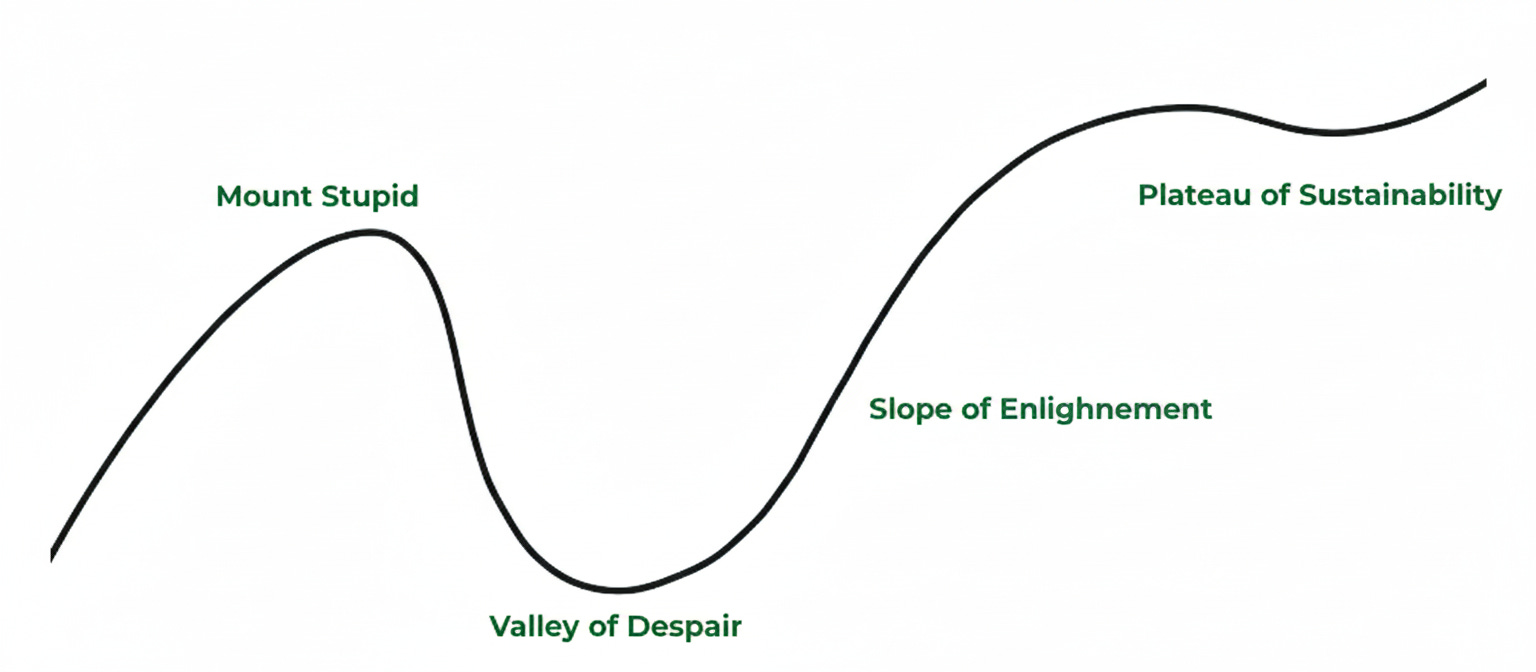
For a better picture of the phenomenon, researchers later modeled a learning curve in four phases:
The peak of “Mount Stupid” (unconscious incompetence): you don’t know what you don’t know, and you’re brimming with confidence.
The valley of despair: you realize how complex it actually is, your confidence collapses.
The slope of enlightenment: you make real progress, confidence gradually rebuilds.
The plateau of sustainability: you finally have a genuine handle on it, with realistic confidence.
The trap? Most people get stuck at the top of Mount Stupid. Because reaching true mastery takes years of effort, practice, and failure.
Three podcasts? That puts you at the summit. Not anywhere near the plateau.
When you’re a leader, this bias turns vicious
Because the Dunning-Kruger effect runs in both directions. And your isolation amplifies both.
First spiral: your overconfidence goes unchallenged
You venture into a new domain. You listen to experts, you read, you understand. Your brain tells you you’ve got it.
In a normal team, someone would say: “Are you sure about this?”
But you’re the leader. When you assert something with confidence, no one pushes back. Your team has learned: contradicting the boss is risky. Especially when you seem so certain.
The result? You can climb Mount Stupid in complete peace. Nobody to tell you you’re at the top. Nobody to help you find your way down into the valley of humility.
Second spiral: generalized expertise
Even more dangerous. You ARE an expert in your domain. You’ve spent 15 years on your sector. You know your product, your market, your customers.
And your brain makes a treacherous shortcut: “If I’m an expert at X, I must be competent at Y, Z, and W too.”
You’ve mastered tech? Your brain convinces you marketing is simple. You’re strong at strategy? Finance seems obvious. Your business is working? Team management can’t be that hard.
And no one around you says: “No - being exceptional at your core expertise doesn’t mean you’ve got everything else covered.”
Third spiral: the invisible underestimation
The flip side is just as dangerous. You ARE genuinely expert in your domain. But no one values it at its true worth. Because to you, it’s obvious. Simple. Basic.
You spend an hour dissecting a complex problem, find the solution in 20 minutes, and think: “Anyone could do this, right?”
No. They can’t.
But because you’re inside your own head, you don’t realize that this ability to see patterns, anticipate problems, find solutions - that’s your 15 years of expertise talking.
The result? You underprice your services. You don’t value what you bring. You think anyone could replace you.
Fourth spiral: the guru effect
The higher you are in the hierarchy, the more people treat you as an expert. On everything. And you’re at the very top.
People ask your opinion on website design. On HR strategy. On accounting software choices. On your LinkedIn comms.
And after being asked your opinion on everything long enough, your brain starts to believe you ARE an expert in everything.
You end up forgetting the difference between “having an opinion” and “having expertise.”
In my work with leaders facing this situation, I never start with “you’re wrong” or “you’re overestimating yourself.” I try to understand the logic behind their certainties.
Often I ask a simple question: “How did you develop this expertise?”
And the pattern surfaces.
“I listened to three podcasts with domain experts.” “I read two reference books.” “I talked with someone who’s been doing it for 10 years.” “I took a 6-hour online course.”
You see the problem? They don’t. Not yet.
Because in their mind, they did the work. They sought out the information. They understood the concepts. Their brain is telling them: “You learned, so you know.”
The turning point is when I ask: “OK, and how long did it take you to become truly expert in YOUR domain?”
Silence.
“15 years.” “8 years of intensive practice.” “Thousands of hours and dozens of failures.”
“And you think that after 6 hours of training, you’ve mastered a domain that took someone else 10 years of practice?”
That’s when it lands. Because verbalizing that dissonance is not the same as vaguely sensing it.
The reverse is equally fascinating. The leaders who underestimate their own expertise.
I ask them: “How long would it take you to train someone to do what you do?”
“Oh, 2-3 weeks max. It’s not that complicated.”
Then we break down together what they actually do. The micro-decisions. The patterns they spot instinctively. The problems they anticipate before they materialize. The solutions they find in 20 minutes that would take anyone else days.
And then: “Ah. It’s not that simple, is it.”
What changes everything in these sessions? Verbalizing it together.
Because alone in front of your screen, you don’t see these patterns. You don’t measure the gap between “understanding” and “mastering.” You don’t realize that what seems obvious to you is the product of 15 years of experience.
An outside perspective asks the questions you don’t ask yourself. Challenges what seems evident. Gives value to what you dismiss as ordinary.
And above all, it creates the space where you can say “I don’t know” without it threatening your credibility as a leader.
How to take back control
1. The transmission test
Before stepping into a new domain, ask yourself: “How long would it take me to train someone to do what I’m about to do?”
If you think 2 hours, but domain experts spend 2 years training their juniors - you’re probably at the top of Mount Stupid.
In my sessions with leaders, we go further. I ask: “Walk me through exactly what you’d do, step by step.” And at each step, we dig: “Why would you make that call? What are you basing it on? What could go wrong?”
Usually within 10 minutes, they realize they can’t answer half my questions. Because understanding the “what” doesn’t give you the “how” - and certainly not the “why.”

2. The reverse 10,000-hour rule
You know the 10,000-hour rule? It takes roughly 10,000 hours of deliberate practice to become expert in a domain.
Flip the logic: count how many hours you’ve genuinely spent PRACTICING (not reading, not listening, PRACTICING) in this new domain.
3 podcasts at 45 minutes each = 2h15. An online course = 6h. Some reading = 10h. Total: roughly 18 hours of “practice” - and most of it is theory.
Most leaders try to solve this by... reading another book. Or listening to one more podcast. But that makes the problem worse, because it gives the illusion of progress while you stay at the same level of theoretical understanding.
With a Sparring Partner, we can press: “You say you understand marketing. Show me. Build me a strategy for your own business, right now.” And very quickly, the gaps become visible.
3. The humility benchmark
Identify 3 genuine experts in the domain you think you’ve mastered. Not influencers - real experts. People who’ve been practicing for 10+ years.
Read their content. Listen to them talk. Observe the level of nuance they bring, their ability to see grey zones, their hesitation in the face of certain questions.
If you have certainties where they have nuances - you’re probably overestimating your level.
Most leaders stop at the observation. In sessions, we go further: “What explains that they see complexity where you see simplicity? What do they know that you don’t?”
4. The confidence audit
List all the domains where you consider yourself competent. For each one, rate your confidence level from 1 to 10.
Then ask 3 people who know you well - and who’ll tell you the truth - to rate your actual level in those same domains.
The gap between the two scores shows you where Dunning-Kruger is hitting.
Alone, this exercise is uncomfortable but limited. In a session, we can explore: “Why this gap? What aren’t you seeing? And more importantly: in which domains are you UNDERESTIMATING yourself, while others see you as the expert?”
5. The expertise vs. opinion map
Draw two columns. Column 1: “I have demonstrated expertise” (10,000+ hours, proven results). Column 2: “I have an opinion” (I’ve read, listened, grasped the concepts).
Then look at your recent strategic decisions. How many came from Column 1? How many from Column 2?
If you’re making major business decisions from Column 2 - you have a problem.
In my engagements, we don’t stop at the map. We dig into each decision: “This marketing call - what was it based on? Your 15 years of experience in tech? Or three podcasts on growth hacking?”
6. The reverse delegation principle
If you wouldn’t delegate this task to a junior with the same level of training you have on the subject - why are you keeping it for yourself?
Example: you completed a 6-hour finance course. Would you hand your treasury management to someone with the same level as you? No? So why are you running it yourself?
Alone, this realization is already powerful. In a session with a Sparring Partner, we can go further: “OK, you’re going to delegate. To whom? How do you evaluate their real competence without falling into the same trap?”
My tips
The decision matrix by expertise level
Before every important decision, put it in one of three categories:
Green zone: my domain of expertise (10,000+ hours). I decide alone. Orange zone: I understand the concepts but don’t have the expertise. I consult a real expert before deciding. Red zone: I don’t have a handle on this. I delegate or I hire.
The trap? Most leaders put 80% of their decisions in the green zone. In a session with a Sparring Partner, you can challenge those classifications and identify the decisions you think are green - but are actually orange.
The predictions journal
Write down your hypotheses and predictions with a date. “I think that by doing X, I’ll get Y in 3 months.”
Re-read them 3 months later. You’ll be surprised at how often you were wrong - especially in the domains where you thought you had it covered.
In a session, you can dig into those recurring patterns: in what kinds of situations do you consistently get it wrong? What does that reveal about your blind spots?
The “I don’t know” rule
Force yourself to say “I don’t know” at least once a day. In meetings. In front of your team. In front of a client.
It protects you from Dunning-Kruger - and it creates a culture where others can say “I don’t know” without losing credibility.
Because if you, the leader, can never say “I don’t know” - how do you expect your team to dare?
The “obvious things” inventory
List everything that seems obvious to you in your business. Then ask someone external - a new hire, a client, a friend who doesn’t know your sector - to ask you questions about them.
You’ll discover that what seems simple to you is actually the product of 15 years of expertise. And that you’re probably undervaluing what you bring.
With a Sparring Partner, you can turn those “obvious things” into premium offers, training, high-value content. Because what’s obvious to you is precious to others.

This week’s challenge
This week, a two-part challenge.
Part 1: Find your “Mount Stupid”
Pick ONE domain where you’ve been making decisions recently, but where your expertise is limited. Marketing, finance, tech, HR - doesn’t matter.
Ask yourself three questions:
How many hours of real practice do I have in this domain? (Not reading - PRACTICE.) How long did it take real experts to master this domain? What have I actually been basing my recent decisions on in this domain?
If your answers are “15 hours,” “10 years,” and “my gut” - you’re probably at the summit.
Part 2: Find your “invisible valley”
Now flip it. Pick ONE domain where you ARE genuinely expert. Your core. What you’ve been doing for 10+ years.
Ask 3 people - team, clients, peers: “What do I do that seems difficult or impressive to you?”
You’ll be surprised. What feels “normal” to you is often what creates the most value. You don’t see it because it’s become unconscious.
The trap? You can do this exercise alone. But alone, you’ll minimize the results. “Oh, that’s nothing, anyone can do that.” No - they can’t.
If you want to actually see your blind spots, you know where to find me. Because sometimes you need someone in front of you to say: “No, what you’re doing there is not ‘normal.’ That’s expertise.”
The Dunning-Kruger effect is human
Your brain wasn’t built to distinguish “understanding a concept” from “mastering a domain.” It does what it can with the information it has.
And as a leader, you don’t have to face this alone.
You don’t have to become an expert in everything. You don’t have to master it all. You don’t have to have an answer for everything.
What matters is knowing where your zones of real expertise are - and where you just have an opinion.
That takes a bit of method. And sometimes, an outside perspective to see what you can’t see on your own.
Ready to take action? Book your discovery call: https://bit.ly/LBkBrief
Next week, we’ll talk about the bias that makes you prefer what already exists - even when it’s clearly the wrong option. And how this resistance to change can turn your business into a Titanic: you can see the iceberg coming, but you keep sailing straight because “changing course feels too risky.”